Ordering a flange requires more than just saying “a 6-inch flange.” The term “flange size” includes several critical numbers. If one is wrong, the flange won’t fit. This article explains the key elements that define a flange’s size and how to specify them correctly.
The Two Most Important Parts of Flange Size
When people ask for flange size, they usually need to provide two things:
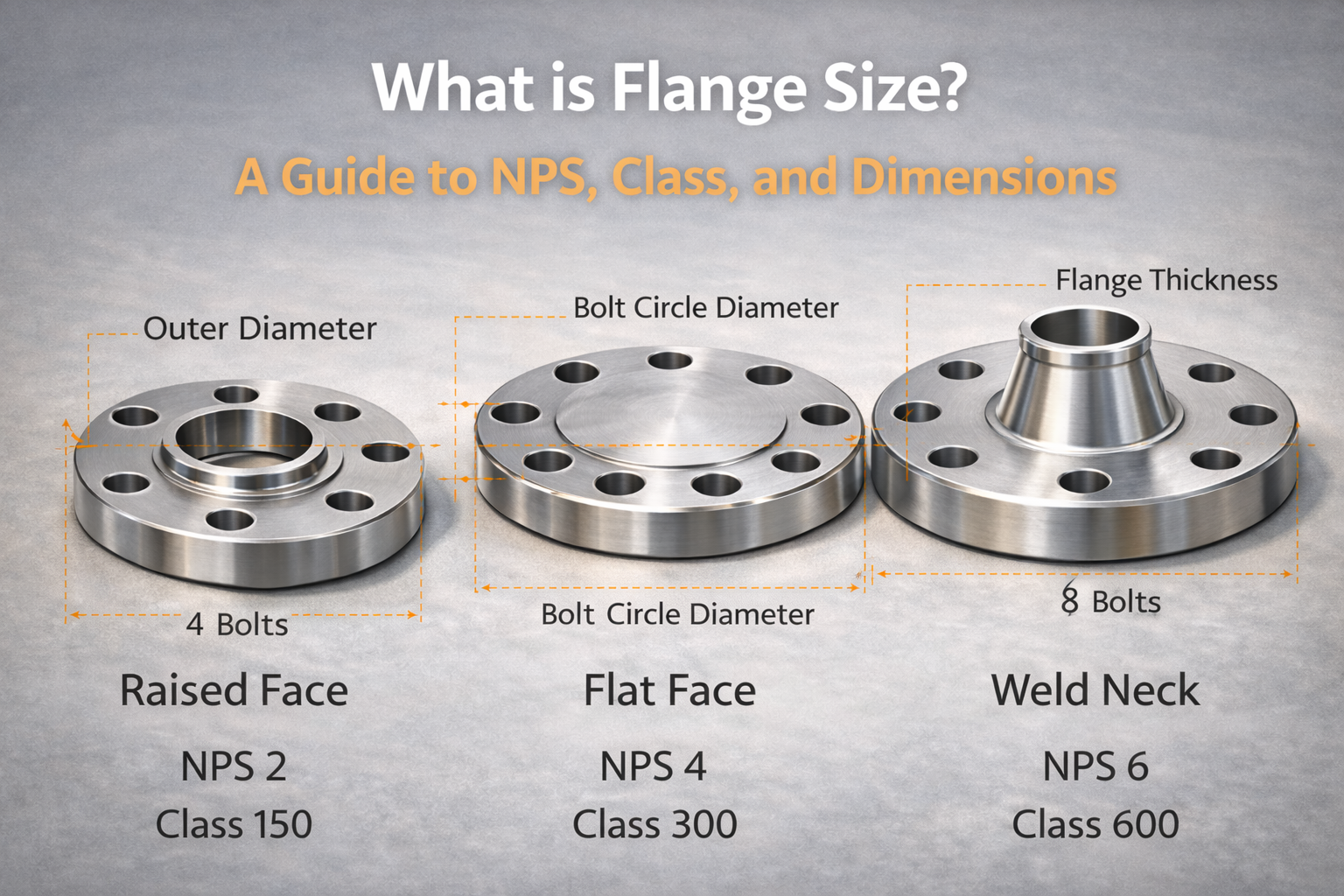
- Nominal Pipe Size (NPS): This is the number related to the pipe it connects to, like NPS 4, NPS 12, or NPS 24. It’s roughly based on the pipe’s inside diameter but is a standardized label, not an exact measurement.
- Pressure Class (or Rating): This number indicates the pressure-temperature rating of the flange. Common classes are 150, 300, 600, 900, 1500, and 2500. A higher number means a thicker, stronger flange for higher pressure.
Why Both NPS and Class Are Required
A “6-inch flange” is incomplete. A Class 150 6-inch flange and a Class 600 6-inch flange have the same bore to fit the same pipe, but their outer diameter, bolt hole count, and thickness are very different. They are not interchangeable. You must specify both numbers.
Key Dimensions That Define a Flange
Beyond NPS and Class, these dimensions are part of the “size” specification. They are found in standard charts (like ASME B16.5).
- Outside Diameter (O.D.): The overall width of the flange face.
- Thickness: The thickness of the flange at its center.
- Bolt Circle Diameter (B.C.D.): The diameter of the circle that passes through the center of all the bolt holes.
- Bolt Hole Diameter: The size of the holes for the bolts.
- Number of Bolt Holes: How many bolts are needed.
- Bore Size: The inner diameter of the flange, which must match the pipe’s outer diameter or schedule.
How Pressure Class Changes Dimensions
For the same NPS, a higher pressure class results in larger physical dimensions. This table shows the trend.
| Dimension | Effect of Higher Pressure Class (e.g., 150 vs. 600) |
| Flange Thickness | Increases significantly. |
| Outside Diameter | Increases. |
| Bolt Circle Diameter | Increases. |
| Number of Bolt Holes | Usually increases. |
| Bolt Hole Diameter | Usually increases. |
Common Standards and Their Impact on Size
The standard you follow determines the exact dimensions. A 6-inch, Class 150 flange has different dimensions in different standards.
- ASME B16.5: The most common standard for flanges NPS 1/2″ to 24″.
- ASME B16.47 Series A & B: For large diameter flanges (NPS 26″ and larger). Series A (MSS SP-44) and Series B (API 605) have different sizes.
- API 6A: For wellhead and christmas tree equipment; uses ring-type joint (RTJ) faces and specific sizes.
- DIN / EN / JIS: International standards with their own dimension tables.
How to Specify a Flange Correctly
To ensure you get the right part, provide this information:
- Nominal Pipe Size (NPS): _____
- Pressure Class (Rating): _____
- Flange Type: _____ (e.g., Weld Neck, Slip-On, Blind)
- Facing: _____ (e.g., Raised Face (RF), Ring Type Joint (RTJ))
- Material: _____ (e.g., A105, 316L Stainless, F91)
- Relevant Standard: _____ (e.g., ASME B16.5, API 605)
Frequently Asked Questions
Q: Does flange size match pipe size exactly?
A: The NPS matches, but the bore size must fit the pipe’s outer diameter. You must know the pipe’s schedule (wall thickness) to ensure the flange bore is correct.
Q: What if my old flange has non-standard dimensions?
A: This happens with older equipment or special designs. You must measure all key dimensions. We can often fabricate a replacement to match.
Q: What is a “drilling” or “bolt pattern”?
A: This refers to the bolt circle diameter (B.C.D.), number of bolt holes, and bolt hole diameter. It is critical for matching two flanges together.
Q: Can you help if I only have a sample or a broken flange?
A: Yes. Providing a sample or accurate measurements of the O.D., B.C.D., bolt holes, and bore allows us to identify or reproduce the correct flange.
Conclusion
Flange size is a combination of its NPS, pressure class, and detailed physical dimensions. Specifying all relevant details prevents fit-up issues and delays on site.
Measuring or specifying flanges can be tricky. If you have drawings, a sample, or just the basic details, we can help identify the exact flange you need.
Send your flange size details or request a dimensional chart here: http://texasflange.com/lp12/